2012年6月11日月曜日

Chapter 16

 In this chapter, I want to write about "Cultivate poised Incompetence" and "Come to terms with Fear". For the first one, I thought this is very important. I remember that Meiland said that students should not be hesitated by their incompetence. I don't remember the exact words, but I remember that he says something like this. This section reminded me of his saying. 
 When I was a captain of the baseball cub in high school, there were some teammates who had never played baseball before. I was very surprised that they tried to start baseball from that time. One of them, who was same grade as me had never touched the ball until then. At first, he was really poor at baseball. However, he was well in motor nerve (運動神経) and he played as a regular player at the last tournament. Why he could become a good player was because he really had a motivation, I think. He was not embarrassed with his incompetence and worked really hard. Most in lunch time break, I went out to the playground and practiced with him. I was glad that he could become a good player.
 Talking about the next part, it is very difficult that we receive "Risk" or "Fear". But if we are in that situation, I think we can enjoy that situation. Three weeks ago, our club finished spring season. The last game was very serious game. I was very nervous during that game. The situation was like this; If we win that game, we can finish the season. If not, we would be lowest rank and have to have match with the top team in the lower division. During that game, there were many times we would lose that game. As I was a pitcher, so the "lose" would be decided if I was hit by the batter. Each times when throwing, I thought we might lose, for many many times. But after other player came to my place and said me something, I lost that "lose fear" and tried to enjoy that situation when I noticed. May be I was enjoying that fear or risk at that time. As a result, we could win the game and successfully win with that fear and risk. That was very good experience for me. 

2012年6月5日火曜日

Case studies

 For this blog, I want to write about the case studies which we did last week.

 My part was Malden Mills, which is a textile company in America. The challenge of the leader of this company, Aaron Feuerstein was to recover this company from an unexpected fire. I would like to show some tactics he used to recoer the situation.

 When the fire came out from the building, he thought that if he could save the 4th building which was safe at that time, and told employees to focus only to save that building. He showed employees short-term objectives and implied that there is still a chance.

 After the accident, they could not do business for about one month. However, he decided to pay salary to all employees, though the debt of the company would become higher. He showed the feeling that we are all one, we die altogether.

 Learning about leaders who used Shackleton's strategy in case studies was very interesting. Also, other members' research were interesting. I really enjoyed last class.

2012年5月30日水曜日

Chapter 10

 In this chapter , the author mostly talked about the Shackleton's behavior's in the expedition, so it was rather difficult to follow the important part for the leader. However, I was very interested in the last part.
 The author says that good leaders think that things do not go smooth and it is natural that things often go wrong. I thought that leaders should act in order to avoid being in not-well situation. So I thought quite opposite from the authors. I learned that the important part of the leader was to welcome the conflict and be motivated to recover the situation. It is very difficult. And I felt that this ability may be come from leader's optimism. If we do not think in a optimistic way, we cannot be motivated to change the situation. I guess every strategy for the leader is somewhat connected.

2012年5月24日木曜日

Comments about Kitashiro's speech

 On Monday we had a speech of Mr.Kitashiro who was the manager of IBM. He had quite a few employees below him, and he made success during his job as a leader.
 I was surprised to realize that he was very sociable and tatlkative person. From his speech to us, I learned a lot of things.He talked about the tips for the ideal leader, and one of them was "Integrity". This means to behave honestly even when other people are not beside you. This was very unique idea to me and has never come up to me. Leaders have to be honest and have to be confident with his behavior. Maybe we lose confident often as a leader, but we should not lose it and be optimistic as a leader.
 Also, he wrote that "be prepared for the meeting." It is very interesting tip. I could not figure out why it is a inportant part for the leader, so I should have asked it.
 Overall he talked many things which were common with Shackleton's skills, so I felt that there are lots in common between ideal leaders.
 This opportunity was very valuable and I really enjoyed this. Thank you, Mr.Kitashiro and Ken.

2012年5月22日火曜日

How to deal troublemakers?

In this part, the author focused on how we should do with the troublemakers in the community. In the expedition, the was some people who troubles others. In those cases, Shackleton tried to set them close to him. Then, he tried not to cause troubles with others. In some time, he let that guy go. In some cases, the author said that it is better to leave them alone.
In today’s discussion, we talked about what we would do with that kind of people. All of us said we would leave them alone. I was among them. However, in a big community or organization, things wouldn’t go like that. There would be a time we have to focus on them even if we do not want to. That is, when troublemaker form groups and have a big influence. In Japan, DPJ always have to consider the Ozawa group’s opinion. In 内閣, there is always a person who is in Ozawa group. The Prime minister does not have a choice but to consider them because they are groups and have a power. So, I think that leaving someone will cause a big trouble, especially in a big group.

2012年5月10日木曜日

5 The Team Message

 It was very interesting to read this chapter. In this chapter, the author writes about the team. The author pointed that treating the upper people and lower people at the same time is difficult but very important point for the leader. The example about Weinbach was surprizing. He tries to make the firm better by collecting a number of opinion from all employees. Showing understanding, is very important. As we learned about the negotiation, that skill is also needed for a leader.
 As is written that Shackleton hold the hair-cut ceremony, and tried to unify crews. It is said "common identity." In sports, I think there is also an example of common identity.
 坊主
There is a kind of custom that high school baseball players shave their heads and make integrity. I think this action is to show their motivation or strength. Also, it would be to share the "common identity." Not only baseball, a high school soccer team "国見" does the same thing. It is very rare in soccer, but it may be a custon of that high school to have thieir common identity.

Be optimistic

 For this post, I would like to write about the Strategy 3, Optimism and reality. As is written, Shackleton was known as a great optimistic person.I also thought that trying to maintain optimistic feeling is important during the expedition.
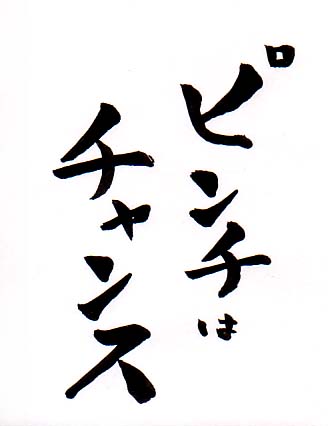
 In this chapter, I was really interested in the Chinese letter "危機”. I have never paid attention to each letters so I was surprised after learning this origin. "危" means danger and ”機” means opportunity. There is a word "ピンチはチャンス” . It means that "Change a pinch to a Chance". This is often said in sports. I learned that kind of optimistic way of thinking is important part for leadership.


Comments about the Wednesday's class

 In yesterday's class, we learned about the 8 tactics for the negotiation. And one of the strategies I am interested was Speed Ups. It was to make the deadline earlier, and bring the decision forward. I had an experience that others once used this tactics to me.
 When I was the third grade in high school, I planned with my friends to go skiing. We looked for the package plan, found a good one. I went to reserve this package, and tried to pay money after collecting all of them. A few days later, I got a phone by the tour company and was told " If you cannot pay money by today, the package would be fully booked by other people."
 In that situation, I guess the company tried to bring our decision forward, and tried to let us fully be a client of that package plan. So it is not certain that the package would be fully booked. I noticed that we and others often use these tactics in our daily lives. 

2012年4月28日土曜日

2nd strategy

"Set a personal example with visible, memorable symbols and behaviors."


 In this part, the author stressed the importance of talking in a big audience. It is much comfortable to speak in a small group than speak in a big group. As a leader, how to perform in that case is important. Also, to perform in a big community, some symbolic actions are good for achieving it. Talking about Shackleton, he threw their gold watches and other precious things, which indicated that he is really trying to face and overcome the difficulties they are in. Shackleton used it well as a symbolic action as a leader. 
  What is your equivalent of throwing gold sovereigns into the snow?
I haven't done a big action like Shackleton, but I always tried to come the first in each practice of our club activities in high school. And I tried to let kouhais follow what I did. I do not know if it is a symbolic things, but I guess it's the same in that Shackleton showed other crews to be motivated with the on-going situation. 

2012年4月24日火曜日

First strategy of leadership

"Never lose sight of the ultimate goal, and focus energy on short-term objectives."


 In this part, it is said that short-term objectives was improtant when Shackleton and others were in a conflict. Also, the author says that assigning something to each crew is important. Therefore, they would be responsible for it and be motivated. I guess it is a kind of "やりがい”in Japanese.
 Now our club has a big objective for spring league. It is to stay in the 3rd division. However, it is a bit big and not clear target. To achieve it, we have to set how many times we have to win and on which team we have to win. I think that these are a kind of short-term objectives. If we think more about those, I think the big-scale objective would become much more realsitic.


 Thanks for reading.


2012年4月14日土曜日

1st post

 It is very difficult to think about the situation I was stretched to my limit. I do not know if this is the correct answer, but I want to write about my experience in my high school.
  
 When I was a high school student, I was a captain of baseball club. Before being a captain, my “senpai” all said that there are no one who is suitable for a captain in our grades. But we had to choose, then I decided to be a leader. I was also anxious about being a captain, but finally I could be a captain being respected by “kouhai” members.
 
 Through my experience, I found that leader has to listen earnestly to other members opinion. Leader should not be a person like a dictator. All one knows that, but sometimes leaders tend to be such a dictator because he or she is the top of the team. What leader should do is to listen to others regardless of their ages and position. For me, I tried to listen to the kouhai’s opinion and tried to make it into practice. From that point, my teammates might regarded me that I was suitable for a captain. So that is what I learned as a leader.